
Everything went well with Cool Drive!
Dionys C.
United States · Aug 2025
Avis Vérifiés
From Highway 1 to the national parks, departing from San Francisco, Los Angeles and San Diego
Campervan hire in California opens up one of the world's great road trips: Highway 1 perched above the Pacific, the giant sequoias, the granite cliffs of Yosemite, then the deserts of Joshua Tree and Death Valley. Our rental partners await you in San Francisco, Los Angeles and San Diego, from two-seater vans to family motorhomes sleeping seven.
The three cities are linked by the coast and one-way hire is possible: you can set off in the north and drop the vehicle off in the south, or loop around the parks from a single depot. All that remains is to choose your route, your season and the size of your vehicle, as California can be explored just as well in two weeks as in a month.
 Avanti Campervans
Rental company category:Economy
 Britz
Rental company category:Standard
Public rating of the rental company:
3.1/5
(10 reviews)
 Cruise America
Rental company category:Standard
Public rating of the rental company:
4.0/5
(8,016 reviews)
 El Monte RV
Rental company category:Standard
 Escape Campervans
Rental company category:Low cost
Public rating of the rental company:
4.4/5
(94 reviews)
 Mighty
Rental company category:Low cost
 Road Bear RV
Rental company category:Premium
Public rating of the rental company:
4.5/5
(130 reviews)
 Star RV
Rental company category:Premium
Public rating of the rental company:
3.5/5
(227 reviews)
 Travellers Autobarn
Rental company category:Low cost
Public rating of the rental company:
4.0/5
(305 reviews)
Choose your departure city: the map shows where rental companies hand over their vehicles.
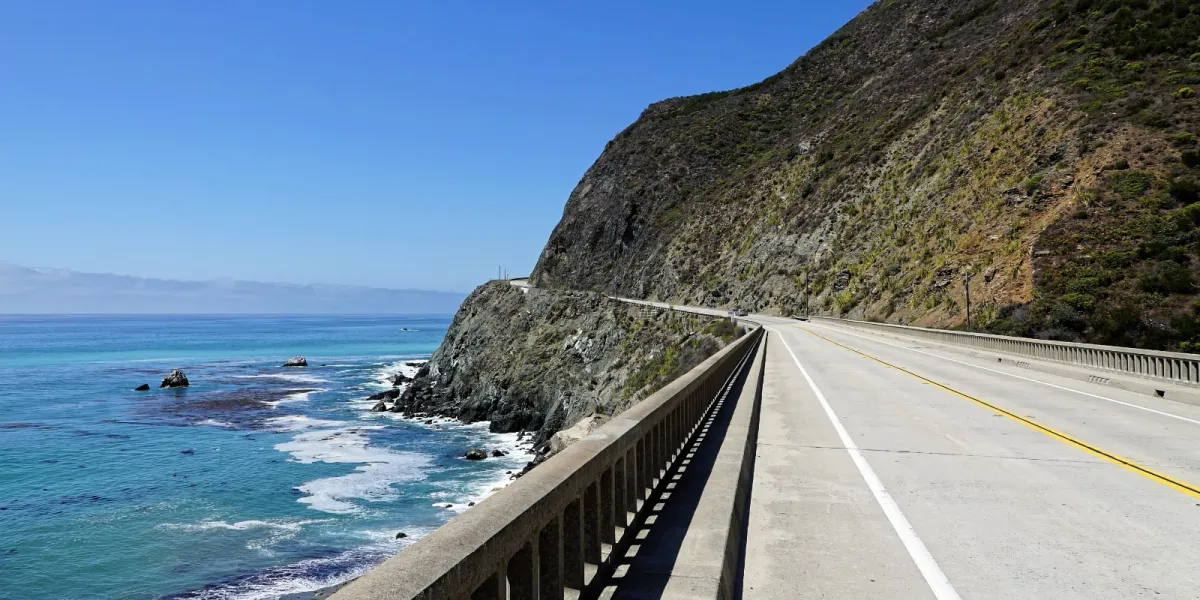
The most famous coastal road in the United States follows the Pacific from Monterey Bay to the beaches of Santa Barbara. Between Carmel and San Simeon, Big Sur strings together cliffs, bridges hanging over the void and wild coves: plan short stages, as the road is winding and one viewpoint follows another.
Landslides regularly close sections of the road through Big Sur: check road conditions before setting off. A van or small motorhome is much easier to park at the viewpoints.
The grand tour of the Sierra Nevada parks: the giant sequoias of Sequoia, Yosemite's glacial valley, Tioga Pass and Mono Lake, then the descent into Death Valley and its dunes. A journey of contrasts, from snow-capped peaks to the lowest land in North America.
Tioga Pass only opens in the warmer months, usually from late May or June to November depending on snowfall: outside this period, the route goes via the south. It ideally ends in Las Vegas or loops back to Los Angeles.
Two hours from Los Angeles, Palm Springs is the gateway to the desert: the Joshua trees and jumbled boulders of Joshua Tree, then the canyons of Anza-Borrego and their spring wildflower blooms. The trip ends on the beaches of San Diego, another departure city for our rental companies.
These deserts are best visited from autumn to spring: in summer, the heat becomes gruelling for travellers and vehicles alike.
North of San Francisco, California shows a different face: the vineyards of Napa and Sonoma, the wild Mendocino coast, the coast redwood forests of Redwood National Park, then Lassen volcano and the blue waters of Lake Tahoe. A cooler, quieter loop, ideal in summer when the south overheats.
The best seasons to combine coast, parks and deserts: the deserts remain bearable, Yosemite's waterfalls are at their peak in spring and autumn brings golden light with fewer crowds. On the coast, the June morning fog known as "June Gloom" often burns off in the afternoon.
Peak season in the national parks: campgrounds fully booked months ahead and busy roads in Yosemite. The deserts become scorching, Death Valley above all, while the coast stays cool. It is the ideal season for the north, the Sierra and Lake Tahoe.
Winter is the season for the deserts, mild and bright, and for the southern coast, often sunny. In the Sierra Nevada, snow closes Tioga Pass and snow chains may be required on the way to Yosemite or Sequoia. Rain mainly affects the north and the San Francisco Bay Area.
San Francisco for Highway 1 and the north, Los Angeles for the parks and deserts, San Diego for the south. A one-way hire saves you retracing your steps.
Look at the included mileage or mileage packages, the kitchen and bedding kits, insurance and the excess: these options matter as much as the daily rate.
First secure national park campgrounds and high-season stops, then fill in the gaps with RV parks, which are easier to find.
Driving licence, credit card in the driver's name and US entry formalities: check the rental company's conditions and the pick-up time before your flight.
In the most visited national parks, Yosemite above all, campgrounds are booked online months in advance and fill up within minutes for the summer. Outside the parks, private RV parks and state park campgrounds take over, with electric hook-ups and dump stations.
Some roads and campgrounds restrict vehicle length, particularly in the parks and on the narrow roads of Big Sur or the Sierra. Before choosing a large motorhome, check the restrictions at the places you plan to visit: a compact model opens more doors.
The Golden Gate Bridge and several San Francisco Bay bridges use electronic tolling with no booths, as do some Los Angeles express lanes. Ask your rental company how these tolls are charged to avoid processing fees.
From summer to autumn, fire risk leads to campfire bans and sometimes road or park closures. Check local alerts before each stage and build some slack into your itinerary.
Our rental partners have depots in San Francisco, Los Angeles and San Diego: Cruise America, El Monte RV, Road Bear RV, Escape Campervans, Indie Campers, Mighty, Britz and Travellers Autobarn, among others. Depots are often on the outskirts: the address and pick-up time are in your confirmation.
Yes, it is the most requested route in California, via Highway 1. One-way fees may apply depending on the rental company: they are included in the displayed price as soon as you enter a different drop-off city when searching. The reverse direction works just as well.
A two-seater van, like the compact campers offered in San Francisco and Los Angeles, can go anywhere and is easy to park on the coast. For families, a Class C motorhome sleeping four to seven offers a shower, toilet and full kitchen, at the cost of a bulkier size in the parks.
Las Vegas is only about 370 km from Los Angeles as the crow flies, and many travellers continue on to Nevada and Arizona. Rental companies generally allow it, but some prohibit Death Valley in midsummer: check the excluded areas in the offer's conditions.
Two weeks lets you combine Highway 1 with one or two national parks. With three weeks, you can add the southern deserts or the north of the state, and a month gives you time to push on to Las Vegas and the Utah parks without a string of long driving days.
Everything went well with Cool Drive!
Quick and friendly customer service.
I have been booking motorhome rentals with Cooldrive and Olivier Sellem since 2018 and I am always very happy with the quality of service and the vehicles.
Rental motorhomes can generally be driven with an ordinary car licence. With a licence issued outside the United States, an International Driving Permit is recommended, and sometimes required by the rental company, in addition to your national licence. The minimum age and length of time holding a licence are set out in the conditions of each offer.
National and state park campgrounds offer the most beautiful pitches, private RV parks the most comfort. In the deserts, some federal lands allow free camping, subject to local rules. In towns, overnight parking is often prohibited: find out before you stop.
Traffic drives on the right, distances and speeds are in miles, and turning right on a red light is often allowed after a full stop. At four-way stops, the first to arrive has priority. Never overtake a stopped school bus with its lights flashing.
Not always: in the United States, many offers charge for the miles driven or offer mileage packages to add on. On a California road trip covering several thousand kilometres, this cost adds up: compare offers with included mileage and estimate your distance before booking.
National parks charge an entrance fee, per vehicle or with an annual pass valid nationwide, which pays off as soon as you visit several parks. Fees, which differ for non-resident visitors, change over time: check them on the official national parks website before you leave.
Several months ahead for July and August and for the spring holidays, at the same time as the park campgrounds. From November to March, outside the end-of-year holidays, there is still plenty of choice a few weeks before departure, especially for desert trips.
Few regions pack so many landscapes into a single trip: the ocean and cliffs of Big Sur, the sequoia forests, the granite domes of Yosemite, the deserts of Joshua Tree and Death Valley. A campervan is the ideal way to link them: you sleep in the heart of the parks, set off at dawn for the viewpoints and stop wherever you like along the coast.
With three departure cities, San Francisco, Los Angeles and San Diego, and the option of one-way hire, every traveller can build their own itinerary: Highway 1 in two weeks, the great parks of the Sierra, the deserts in winter or the wilder north in summer. California also extends towards Las Vegas, the Grand Canyon and Utah for the greatest road trips of the American West.