
The steps to reserve a motorhome are so easy, just follow your steps and you’re done!
Campervan hire in Sardinia lets you circle an island where every coast has its own character: the turquoise waters of the Costa Smeralda and the La Maddalena archipelago, the limestone cliffs of the Gulf of Orosei, the nuraghi of the interior and the dunes of the west coast. Our rental partners are based in Olbia, Cagliari and Sassari, as well as in Porto Torres for the Alghero area.
Arriving by plane or ferry and picking up the vehicle on the island saves you a crossing with a motorhome. Olbia opens up the north-east and Gallura, Cagliari the south and its beaches, Sassari the coast around Alghero and Stintino. Then decide which way round to go and when: allow one week for a single area, two to three for a full tour of the island.
Our 3 rental partners in Sardinia
Where to pick up your motorhome in Sardinia?
Choose your departure city: the map shows where rental companies hand over their vehicles.
The best itineraries in Sardinia
1 Gallura and the Costa Smeralda, from Olbia to Alghero
- Olbia
- Porto Cervo
- Palau
- Santa Teresa Gallura
- Castelsardo
- Stintino
- Alghero
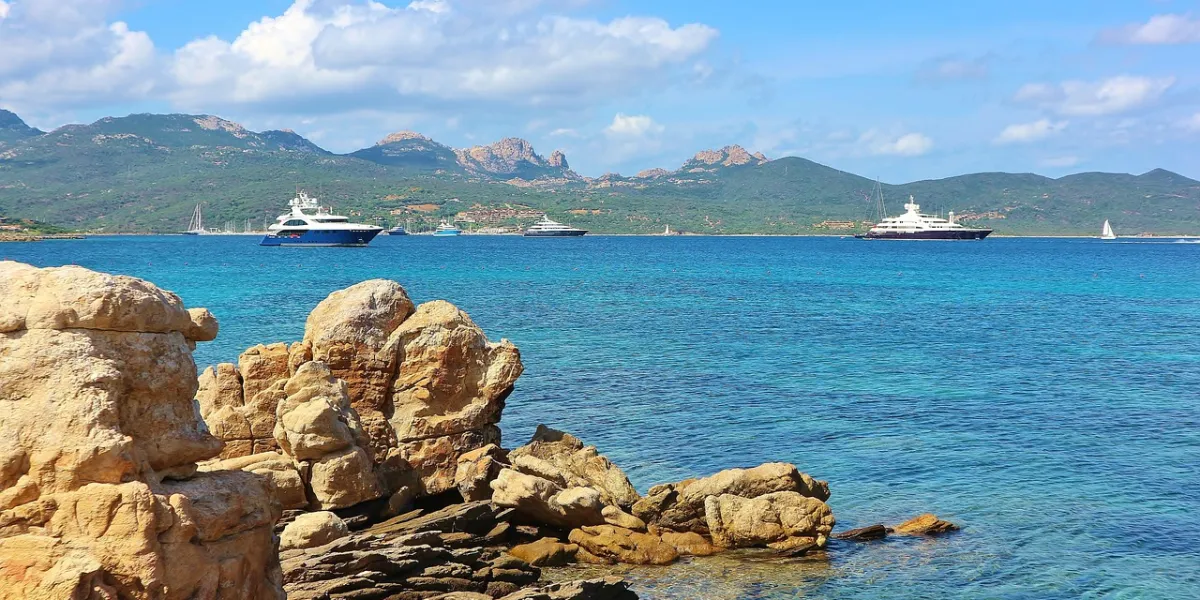
In the north-east, the Costa Smeralda strings together clear-water coves and wind-carved granite boulders from Porto Cervo to Baja Sardinia. From Palau, ferries cross to the La Maddalena archipelago, a national park; further on, Santa Teresa Gallura and Capo Testa look across to Corsica before the road drops down to Castelsardo, perched on its headland.
The trip ends in Stintino, by La Pelosa beach, then in Alghero. The coastal roads of Gallura are narrow and winding: a van or compact motorhome slips through more easily and is simpler to park near the beaches.
- Distance
- about 300 km
- Recommended vehicle
- Van or compact motorhome
2 The Gulf of Orosei and the Orientale Sarda
- Olbia
- San Teodoro
- Orosei
- Cala Gonone
- Baunei
- Arbatax
- Villasimius
- Cagliari
South of Olbia, the east coast leads to San Teodoro and then the Gulf of Orosei, heart of the Gulf of Orosei and Gennargentu National Park: from the port of Cala Gonone, boats serve Cala Luna and coves that no road reaches. The SS125, the ‘Orientale Sarda’, then crosses the Supramonte via the Genna Silana pass.
After Baunei and Arbatax, the road descends towards the coast at Muravera and Villasimius before reaching Cagliari, where you can return the vehicle if the company accepts one-way hire. Plan short stages on the SS125: tight bends and steep gradients slow progress considerably.
- Distance
- about 400 km
- Recommended vehicle
- Compact motorhome or van
3 The south-west, from Chia to the Costa Verde
- Cagliari
- Nora
- Chia
- Sant'Antioco
- Carloforte
- Iglesias
- Piscinas
- Cagliari
From Cagliari, the road passes the ancient site of Nora and the beaches of Chia, then follows the Costa del Sud, a corniche hanging above deserted coves. A causeway leads to the island of Sant'Antioco; from Calasetta, a ferry sails to Carloforte and the island of San Pietro, whose culture has Ligurian roots.
The way back follows the mining coast of Iglesias, where the Pan di Zucchero sea stack rises off Masua, then the great dunes of Piscinas on the Costa Verde. A relaxed loop for spring or September, when the beaches empty.
- Distance
- about 350 km
- Recommended vehicle
- Van or small motorhome
4 From Cagliari to Sassari via the nuraghi and the west coast
- Cagliari
- Barumini
- Oristano
- Tharros
- Bosa
- Alghero
- Sassari
This south-to-north route crosses the Sardinia of the nuraghi: the Su Nuraxi site at Barumini, a World Heritage Site, then Oristano and the Sinis peninsula, with the ruins of Tharros and the quartz-grain beaches of Is Arutas. Further north, Bosa stacks its colourful houses along the River Temo.
The panoramic road from Bosa to Alghero runs along cliffs with almost no villages: set off with a full tank. Alghero, with its Catalan accent, then offers Capo Caccia and Neptune's Grotto before you return the vehicle in Sassari.
- Distance
- about 300 km
- Recommended vehicle
- All types of motorhome
When to go in Sardinia?
Spring and early autumn
The best seasons for walking to the coves of the Gulf of Orosei and visiting the nuraghic sites: moderate heat, campsites with space and a sea already pleasant in June. In September, the water keeps its summer warmth, still 26 °C in Cagliari, while the crowds have gone home.
July and August
Peak beach season: crowded beaches on the Costa Smeralda and in Villasimius, ferries fully booked around 15 August and campsites to reserve well ahead. It almost never rains, barely 1 mm in July in Cagliari, and the heat inland makes early-morning driving the best option.
November to March
Sardinian winters are mild on the coasts but wetter, with November topping the list at 110 mm in Alghero. Many campsites and beach restaurants close: focus on the towns of Cagliari, Alghero and Sassari and on the archaeological sites. In the Gennargentu, snow can reach the mountain roads.
Renting in Sardinia, step by step
-
1
Choose your starting point
Olbia for Gallura and the east coast, Cagliari for the south and the Orientale Sarda, Sassari or Porto Torres for Alghero and the north-west. Match this choice to your arrival airport or port.
-
2
Compare offers
Look at the number of berths, the included mileage, the crockery and bed linen provided, the insurance cover and the amount of the excess. An awning and an outdoor shower are a real plus for beach days.
-
3
Book your summer stops
In July and August, campsites near Cala Gonone, Villasimius, Palau or Stintino fill up fast: book them together with the vehicle and keep the rest of the itinerary flexible.
-
4
Prepare for pick-up
Agencies usually sit outside the town centres: check the address and pick-up time, then plan a transfer from the airport or port. A driving licence and a credit card held by the main driver are required.
Everything to know before hitting the road
Nearby islands: check with the rental company first
The La Maddalena archipelago from Palau and the island of San Pietro from Calasetta or Portovesme can be reached by ferry with the vehicle. Before boarding, check that your rental company allows these crossings and that the insurance covers them; also check timetables and fares, which change with the season.
Beaches: regulated access and parking
At the busiest beaches, car parks often start charging in summer and some have height barriers. La Pelosa, near Stintino, and several coves on the Gulf of Orosei limit or regulate access: check the conditions before you go. Taking sand, pebbles or shells is prohibited and fined.
Mistral winds and fire risk
The mistral, known locally as the ‘maestrale’, blows hard on the north and west coasts: open doors and awnings with care and slow down on exposed ridges. In summer, fire risk leads to bans on outdoor fires and barbecues; strictly follow local instructions and respect closed areas.
Historic centres in ZTL zones
The old towns of Cagliari, Alghero and Sassari are limited traffic zones, or ZTL, monitored by cameras: entering without authorisation means a fine, sent to the rental company and passed on to you with fees. Park on the outskirts, in a car park or a motorhome area, and continue on foot or by bus.
Your questions about a road trip in Sardinia
Where can I pick up a campervan in Sardinia?
Our rental partners are based around Olbia, with Camper Sardegna in Porto San Paolo and Motorhomes Italy; around Cagliari, with McRent in Selargius and Motorhomes Italy in Quartu Sant'Elena; and in Sassari, with McRent. For the Alghero area, Motorhomes Italy hands over its vehicles in Porto Torres. The exact address is in your confirmation.
Is it better to rent on the island or come from the mainland?
Renting on the island avoids the cost and hassle of crossing with a motorhome, especially in summer. Starting from the mainland, from Rome for example, is still possible if the rental company allows the ferry: crossings from Civitavecchia, Livorno or Genoa arrive in Olbia, Golfo Aranci, Porto Torres or Cagliari. Check this authorisation before booking.
Van or motorhome: which suits Sardinia best?
In Cagliari, the choice ranges from 2-berth vans to 6-berth motorhomes, including family models with five seats. A van parks easily near the coves and handles the Orientale Sarda without difficulty; families will appreciate the shower and kitchen of a low-profile or over-cab motorhome, which is bulkier on minor roads.
Can I take the motorhome to Corsica?
Corsica is only a short crossing from Santa Teresa Gallura to Bonifacio, and many travellers are tempted. It requires the rental company's written consent, insurance and breakdown cover valid in France, and a ferry booking matching the vehicle's length. Without consent, leave the motorhome behind and cross as a foot passenger for the day.
How long should a Sardinia trip last?
One week is enough for one area, Gallura from Olbia or the south-west from Cagliari. Two weeks let you link Olbia to Cagliari via the Gulf of Orosei and head back north through the interior or along the west coast. Three weeks give time for a full tour, including the La Maddalena and San Pietro islands.
They travelled in Sardinia with CoolDrive Nomad
Serious platform that offers relatively advantageous rates compared to a direct rental. The follow-up and ordering process are planned and quick, and the little reminders before departure are welcome. And when there is a minor issue with the rental company, the Cooldrive team takes care of sorting things out (thank you Marlène for the refund) and finding a solution to ensure our customer experience remains the best possible...and that is more than cool! So, yes...I recommend Cooldrive!
Good and quick communication, easy to book and easy to follow all the instructions.
FAQ — Campervan hire in Sardinia
What licence do I need for a rental motorhome in Sardinia?
Most rental motorhomes can be driven with a standard car licence (category B); the heaviest models require a higher category. With a licence issued outside the European Union, find out which documents Italy requires, an International Driving Permit or a translation, and what the rental company asks for. The minimum age is shown in each offer's conditions.
Where can I spend the night in Sardinia?
Campsites are plentiful along the coasts, from Gallura to Villasimius, and motorhome areas, the ‘aree di sosta’, complete the network with water and waste disposal. Wild camping depends on each municipality: many ban it near beaches in summer. Check locally before spending the night anywhere other than a designated site.
Are there tolls in Sardinia?
No: unlike the mainland, where the vast majority of motorways are tolled, the island has no toll motorway. The four-lane SS131 links Cagliari to Sassari and Porto Torres free of charge, and a branch serves Nuoro and Olbia. The rest of the network consists of national and provincial roads, often winding.
What are the rules for a bike rack?
In Italy, any load projecting at the rear, such as a loaded bike rack, must carry a red and white striped warning sign. Ask the rental company for one with the equipment or buy one before setting off, as a missing sign is fined. Also make sure the bikes do not hide the number plate or the lights.
How far ahead should I book in Sardinia?
As early as possible for July or August departures, and above all for the week of 15 August, Ferragosto, when Italian holidaymakers flock to the island. In spring, September and October, a few weeks ahead is usually enough. In winter, there is plenty of choice, but check the opening days of your departure depot.
Where can I fill up with water and empty the tanks?
Campsites and motorhome areas generally have a service point, sometimes for a fee. Emptying grey water or toilets anywhere else, in nature or in a car park, is prohibited and fined. In summer, water can be rationed in some municipalities: fill the tank whenever you get the chance.
Why explore Sardinia by campervan
Sardinia lends itself to touring: its finest beaches are often far from the towns, at the end of coastal roads you can drive at your own pace. In a campervan, you spend the morning in a Gallura cove, the afternoon on the trails of the Supramonte and the evening near an inland village, where Sardinian culture, with its nuraghi, festivals and sheep's cheeses, is still very much alive.
With departures in the north-east at Olbia, in the south at Cagliari and in the north-west at Sassari, the island can be explored piece by piece or end to end, one way when the rental company offers it. The shoulder seasons are the most beautiful: maquis in bloom in spring, a still-warm sea in September, quieter campsites. And to go further, the La Maddalena archipelago, San Pietro or Corsica are just a crossing away.