

Good and quick communication, easy to book and easy to follow all the instructions.
Campervan hire in Tuscany lets you link the art cities and the countryside around them at your own pace: the wine hills of Chianti, the cypress trees of the Val d'Orcia, the towers of San Gimignano, then the beaches of Versilia and the Maremma. Our partner companies have vehicles sleeping two to six ready for you in Florence, Pisa, Lucca and Siena.
Distances here are short and every day can bring a new setting: museums in the morning, ridge roads in the afternoon, a night on a motorhome area below a medieval hill town. The flip side is narrow country lanes and historic centres closed to traffic: the size of the vehicle and the season matter as much as the route.
Our 6 rental partners in Tuscany
Where to pick up your motorhome in Tuscany?
Choose your departure city: the map shows where rental companies hand over their vehicles.
The best itineraries in Tuscany
1 Florence, Chianti and the towers of San Gimignano
- Florence
- Greve in Chianti
- Castellina in Chianti
- Siena
- Monteriggioni
- San Gimignano
- Volterra
- Florence
Between Florence and Siena, the Chiantigiana road winds through vineyards, olive groves and fortified villages: Greve, Panzano, Castellina, then Radda. After Siena and its Piazza del Campo, the loop heads back north via the walls of Monteriggioni, the medieval towers of San Gimignano and the alabaster workshops of Volterra before returning to Florence.
Chianti's roads are narrow and twisting: a van or compact motorhome handles them far more comfortably. San Gimignano has no rental depot but is an easy visit from Florence or Siena.
- Distance
- about 250 km
- Recommended vehicle
- Van or compact motorhome
2 Val d'Orcia and the Maremma, south of Siena
- Siena
- Crete Senesi
- Montalcino
- Pienza
- Montepulciano
- Saturnia
- Pitigliano
- Orbetello
- Siena
From Siena, the road crosses the clay ridges of the Crete Senesi before reaching the Val d'Orcia, with its cypress-lined hills and hilltop villages: Montalcino, Pienza, Montepulciano. The circuit then drops down to the hot springs of Saturnia, the tufa town of Pitigliano and the Orbetello lagoon.
The Val d'Orcia villages close their centres to vehicles: park in the car parks at the entrance. The thermal cascades at Saturnia are free to access but very busy in summer and at weekends.
- Distance
- about 400 km
- Recommended vehicle
- All types of motorhome
3 The Tuscan coast, from Pisa to the Maremma
- Pisa
- Livorno
- Castiglioncello
- Bolgheri
- Populonia
- Massa Marittima
- Castiglione della Pescaia
- Alberese
From Pisa, the coast runs south through Livorno and the cliffs of Castiglioncello, then the cypress avenue of Bolgheri. Further on, the Etruscan acropolis of Populonia looks down on the Gulf of Baratti, before the old mining streets of Massa Marittima and the pine forest of Castiglione della Pescaia, on the edge of the Maremma nature park.
Inside the park, vehicle access to some beaches is restricted: plan to leave the motorhome at the entrance and continue on foot or by shuttle. In August, coastal campsites fill up fast.
- Distance
- about 250 km
- Recommended vehicle
- Low-profile motorhome or van
4 Lucca, the Garfagnana and the Apuan Alps
- Lucca
- Borgo a Mozzano
- Barga
- Castelnuovo di Garfagnana
- Carrara
- Pietrasanta
- Viareggio
- Lucca
North of Lucca and its tree-lined walls, the Serchio valley leads to the medieval Ponte della Maddalena, known as the Devil's Bridge, at Borgo a Mozzano, then to the villages of Barga and Castelnuovo di Garfagnana. The return leg crosses the Apuan Alps to the marble quarries of Carrara and reaches the sea in Versilia.
Roads in the Apuan Alps are steep and narrow: a compact vehicle is more at ease there. Blurent also offers a pick-up point at Pallerone, in the north of the region.
- Distance
- about 200 km
- Recommended vehicle
- Van or compact motorhome
When to go in Tuscany?
April to June
Spring covers the hills in green wheat and poppies: the ideal moment for the Val d'Orcia and Chianti. May is still fairly wet, with more than 100 mm of rain in Florence and Pisa, but June brings sunshine, long days and the first swims along the coast.
July and August
Dry heat inland, lively beaches from Versilia to the Maremma and a peak in visitors around 15 August, Ferragosto. In Siena, the two Palio horse races, on 2 July and 16 August, fill the city. Visit towns early in the morning and keep the afternoons for shade or the sea.
September and October
Grape harvest season in Chianti and around Montalcino, with golden light and quieter roads once August is over. Expect some rainy days: September and October are among the wettest months in Florence and Pisa, often with thunderstorms.
November to March
The art cities can be visited without crowds, Florence first and foremost, and the olive harvest brings the countryside to life in November, the rainiest month in both Florence and Pisa. Several campsites close in winter: check their opening dates and favour motorhome areas open all year.
Renting in Tuscany, step by step
-
1
Choose your starting point
Florence and Calenzano for Chianti and the art cities, Pisa or Lucca for the coast and the Garfagnana, Siena for the Val d'Orcia and the Maremma. Monsummano Terme, between Florence and Lucca, puts you at the heart of northern Tuscany.
-
2
Compare the offers
Included mileage, kitchen and bedding equipment, bike racks, insurance options and permitted roads vary from one company to another as much as the rate, which the search shows for your exact dates.
-
3
Book the key stops
Secure coastal campsites for August and nights near Siena during the Palio first, then fill in with aree di sosta, which are more flexible and often just a few minutes' walk from the town centres.
-
4
Prepare for pick-up
Confirm the exact address and handover time: several depots lie outside the centres, on business parks or in the suburbs, which also keeps you out of the ZTLs. Plan the journey from the airport or station, and bring a credit card issued to the main driver.
Everything to know before hitting the road
Never enter a ZTL
Florence, Pisa, Siena, Lucca and most Tuscan towns protect their historic centres with a ZTL, a limited traffic zone monitored by cameras. Driving past the sign without a permit means a fine, often passed on by the rental company months later. Sat navs do not always show them: locate them before you arrive.
Strade bianche and large vehicles
In Chianti and around Siena, many minor roads are strade bianche, white gravel tracks. Fine for a car, they shake a motorhome about and throw up a lot of dust. Some rental companies exclude unpaved roads from their cover: check the conditions and stick to tarmac in a large model.
Bike racks and the striped sign
Tuscany is also a cycling destination, from the strade bianche of L'Eroica to the cycle paths of Versilia. If bikes stick out at the back of the motorhome, a square red-and-white striped sign must mark the load: ask the rental company whether it supplies one with the bike rack.
Tolls: ticket on entry, pay on exit
The A1, A11 and A12 motorways are tolled: you take a ticket on entry and pay on exit, in cash or by card, avoiding the lanes reserved for Telepass. The Florence-Pisa-Livorno expressway and the Florence-Siena link road, on the other hand, are free.
Your questions about a road trip in Tuscany
Where can I rent a motorhome in Tuscany?
Anywhere Campers has depots in Florence, Pisa, Lucca and Siena; Autocaravan Express and Motorhomes Italy in Florence, the latter also in Calenzano; McRent in Pisa; Rent Easy in Barberino Tavarnelle, in Chianti south of Florence; and Blurent in Monsummano Terme and Pallerone. Your confirmation gives the exact meeting point.
Can I return the motorhome in another Tuscan city?
That depends on the company and the depot. To find out, choose a different drop-off location in the search engine, for example starting in Florence and returning to Pisa after the coast: the matching offers are then displayed, with any one-way fees already included in the price.
Van or motorhome for Tuscany?
The Van for 2 offered in Pisa suits couples who want to slip through villages and along Chianti's lanes. Families will find models sleeping five or six, such as the Adria Matrix or the Sunlight A70, more comfortable but trickier to park near the hilltop towns.
Can I take the ferry to Elba?
Ferries link Piombino to Portoferraio in about an hour, and a motorhome can board if the rental company allows it: check the offer's conditions before booking the crossing. Timetables and fares vary with the season and the vehicle's length; in summer, book your passage well in advance.
How long should I plan for Tuscany?
One week is enough for Florence, Chianti, Siena and San Gimignano. With two weeks you can add the Val d'Orcia and the Maremma coast, or Lucca and the Garfagnana. Three weeks let you combine everything without rushing and keep a few days of rest at an agriturismo.
They travelled in Tuscany with CoolDrive Nomad
Cooldrive was very attentive and very responsive in all situations. We received valuable assistance in the steps to be taken. I highly recommend it.
The person answered my questions before I confirmed the booking. The van matched my order well with extras. During my trip, I had a little issue that had nothing to do with Cooldrive. I appreciated that the person took the time to call me back. No bad surprises, only good ones. Highly recommended.
FAQ — Campervan hire in Tuscany
Which licence do I need for a rental motorhome in Tuscany?
Rental motorhomes up to 3.5 tonnes can be driven on a category B licence. A licence issued in the European Union is enough; with a licence issued outside the EU, ask the rental company whether an international driving permit or a translation is required. The required age and years of driving experience vary between offers.
Where to spend the night with a motorhome in Tuscany?
Aree di sosta, dedicated motorhome areas often close to historic centres, and campsites, plentiful on the coast, are the simplest options. Some agriturismi also welcome motorhomes. Overnight parking elsewhere depends on each municipality's bylaws, which are often stricter on the coast: ask locally before settling in.
When should I book a motorhome in Tuscany?
For July and August, several months ahead, at the same time as the coastal campsites. The spring long weekends around Easter, 25 April and 1 May are also in high demand among Italian travellers. From November to March, vehicles are still easy to find a few weeks before departure, except over Christmas and New Year.
Can I reach the Cinque Terre or Rome?
Yes. The Cinque Terre, in Liguria, are best visited from La Spezia, about 60 km as the crow flies from Pisa: leave the motorhome there and take the train, as the roads to the villages are narrow and parking very limited. Rome is about three hours' drive from Florence on the A1 motorway.
Can I swim in Tuscany?
Yes, from June to September: near Pisa the sea reaches 24 °C in June, 27 to 28 °C in July and August, and is still 25 °C in September. The equipped beaches of Versilia alternate with the coves of Populonia and the long wild beaches of the Maremma park. Many beaches charge for access, with parasols and loungers.
Do I need winter equipment?
In Italy, many roads require winter tyres or snow chains on board during the cold season, generally from mid-November to mid-April, including the A1 motorway between Florence and Bologna across the Apennines. Check that the motorhome is equipped and find out about the rules on your planned roads, especially towards the Apuan Alps or Monte Amiata.
Why tour Tuscany by motorhome
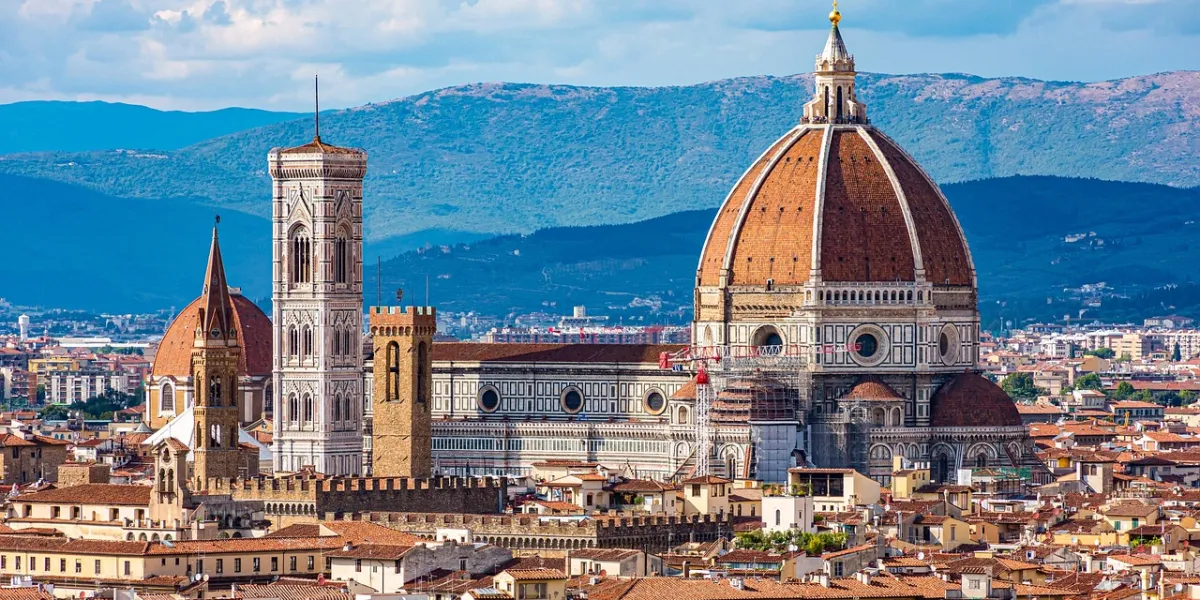
Tuscany packs into a compact area what you would often seek over several trips: the museums and dome of Florence, the Leaning Tower of Pisa, the walls of Lucca, Siena's Piazza del Campo and, between them, a landscape of vines, olive trees and cypresses. By motorhome, you move from one hill to the next without repacking and sleep below a hilltop village or facing the sea.
The starting points are spread across the north and centre of the region, from Pisa and Lucca near the coast to Florence and Siena inland, with suburban pick-ups in Calenzano, Monsummano Terme or Pallerone. Each opens up a different route: Chianti and San Gimignano, the Val d'Orcia and the Maremma, the Etruscan coast or the mountains of the Garfagnana. Umbria, the Cinque Terre and Rome are all within driving range.