
Very good from the quote to the rental, I recommend!
Australia's Northern Territory is made up of two almost opposite landscapes. In the north, the Top End: savannah, wetlands, waterfalls and floodplains, under a tropical climate shaped by a dry season and a wet season. In the south, the Red Centre: ochre rocks, hidden gorges, Uluru and a desert where winter nights are cold. Two departure cities are available: Darwin and Alice Springs.
The Stuart Highway, which crosses the territory from north to south, links them. Distances are long, petrol stations are sometimes several hundred kilometres apart, and you drive on the left. Fourteen rental companies operate in the region, from compact campervans to 4x4 campers: the choice of vehicle matters as much as the choice of season.
Our 14 rental partners in the Northern Territory
-
Adventure Rentals
Rental company category:Standard
Public rating of the rental company:
4.6/5
(36 reviews)
-
Apollo
Rental company category:Standard
Public rating of the rental company:
3.8/5
(12 reviews)
-
Britz
Rental company category:Standard
Public rating of the rental company:
3.1/5
(10 reviews)
-
Campervan Village
Rental company category:Economy
Public rating of the rental company:
2.9/5
(139 reviews)
-
Cheapa Campa
Rental company category:Low cost
-
Crikey Camper Hire
Rental company category:Standard
-
Jucy Rentals
Rental company category:Economy
Public rating of the rental company:
3.5/5
(1,223 reviews)
-
Let's Go Motorhomes
Rental company category:Economy
-
Maui
Rental company category:Premium
Public rating of the rental company:
4.0/5
(499 reviews)
-
Mighty Campers
Rental company category:Low cost
Public rating of the rental company:
4.0/5
(334 reviews)
-
Red Dirt 4WD Rentals
Rental company category:Premium
-
RedSands Campers
Rental company category:Premium
-
Star RV Rentals
Rental company category:Premium
-
Travellers Autobarn
Rental company category:Low cost
Public rating of the rental company:
4.0/5
(305 reviews)
Where to pick up your motorhome in the Northern Territory?
Choose your departure city: the map shows where rental companies hand over their vehicles.
The best itineraries in the Northern Territory
1 Kakadu and Katherine, a loop from Darwin
- Darwin
- Ubirr
- Jabiru
- Yellow Water
- Pine Creek
- Katherine
- Darwin
The loop heads east along the Arnhem Highway, crosses the Mary River plains and then enters Kakadu National Park. There you can visit the rock art at Ubirr, the wetlands and the bird- and crocodile-watching cruises at Yellow Water. The road continues along the Kakadu Highway to Pine Creek, then to Katherine and its gorges, before heading back to Darwin.
During the wet season, some roads and sites in the park close because of flooding: check the park's information before you leave. Access to several waterfalls is by dirt tracks, often excluded from rental agreements.
- Distance
- about 900 km
- Recommended vehicle
- Motorhome or campervan; 4x4 if tracks are permitted
2 Litchfield and its waterfalls, a short getaway from Darwin
- Darwin
- Batchelor
- Florence Falls
- Wangi Falls
- Darwin
Litchfield National Park is about two hours' drive from Darwin. It brings together waterfalls with accessible pools, such as Florence Falls and Wangi Falls, and giant termite mounds aligned north-south. This getaway suits a long weekend or a first stage before a bigger circuit.
The main access roads are sealed, which suits motorhomes. Swimming depends on the state of the water: after rain, some pools are closed or the current is strong. Respect the signs, particularly those warning of possible crocodiles.
- Distance
- about 350 km
- Recommended vehicle
- All types of motorhome and campervan
3 The Stuart Highway, from Darwin to Alice Springs
- Darwin
- Katherine
- Mataranka
- Tennant Creek
- Devils Marbles
- Alice Springs
This straight line from one ocean to the other crosses the territory from north to south. Katherine marks the end of tropical country, then come Mataranka and its hot springs, followed by Tennant Creek and the rounded granite boulders of Karlu Karlu, the Devils Marbles. You finish in the desert, at Alice Springs.
The stages are long and petrol stations are rare: always keep a fuel margin. A one-way rental between Darwin and Alice Springs is not offered everywhere: it all depends on the rental company and the period. Otherwise, plan to return along the same route.
- Distance
- about 1,500 km
- Recommended vehicle
- Coachbuilt motorhome or campervan
4 The MacDonnell Ranges, from Alice Springs
- Alice Springs
- Simpsons Gap
- Standley Chasm
- Ormiston
- Glen Helen
- Alice Springs
West of Alice Springs, the West MacDonnell Ranges line up gorges with red walls and pools of fresh water. The sealed road serves Simpsons Gap, Standley Chasm, Ellery Creek and Ormiston, then stops near Glen Helen. Each site is visited on foot along short trails.
Set off early, as the heat rises quickly on exposed trails, and carry more water than you think you need. The pool water is cold in winter, but fine for swimming in summer.
- Distance
- about 300 km
- Recommended vehicle
- Compact motorhome or campervan
5 Kings Canyon and Uluru, from Alice Springs
- Alice Springs
- Erldunda
- Kings Canyon
- Yulara
- Uluru
- Alice Springs
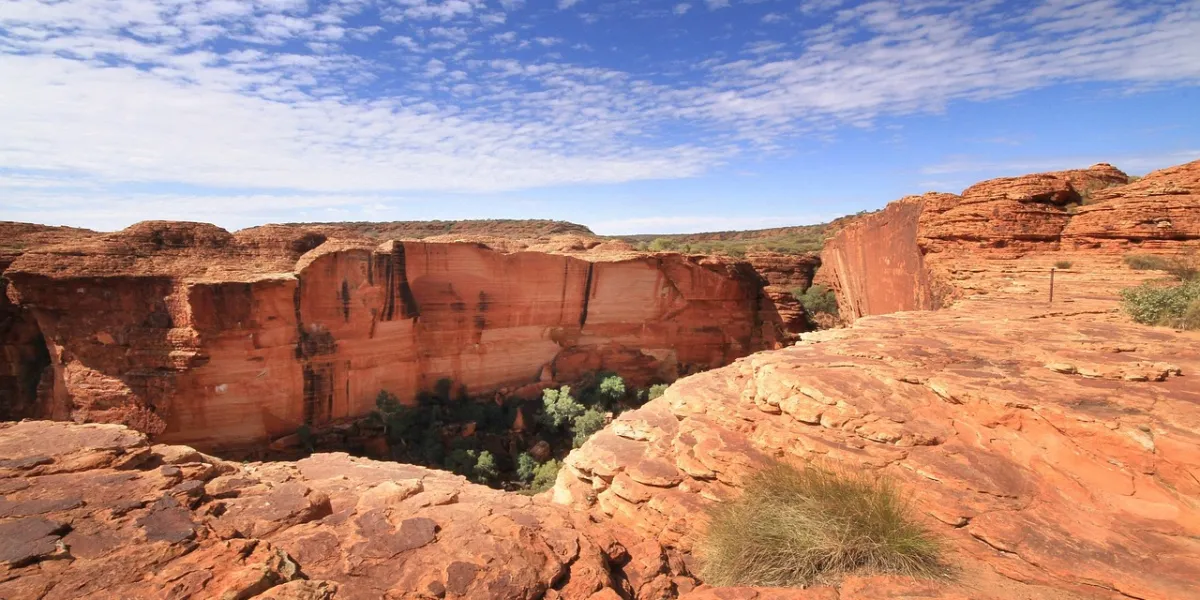
The Stuart Highway runs south to Erldunda, then the Lasseter Highway heads west. A turn-off leads to Kings Canyon, in Watarrka National Park, where the rim walk gives a view over the desert. The road continues to Yulara, the base for Uluru-Kata Tjuta National Park.
Stay on the sealed roads: the tracks of the Centre, such as the Mereenie Loop, are often excluded from agreements and require a permit. Distances are great, with very few services between stops.
- Distance
- about 1,250 km
- Recommended vehicle
- Coachbuilt motorhome or campervan
When to go in the Northern Territory?
May to September, the dry season
This is the most pleasant period for the Top End: in Darwin, only 18 mm of rain falls in May, 7 mm in June and July, 4 mm in August, with nearly eleven hours of sunshine a day. The sea stays at 26 °C or more. In Alice Springs, the days are mild but the nights cool: lows drop to 6.6 °C in July.
October and November, heat and the first storms
This transition heralds the wet season. In Darwin, rainfall rises to 71 mm in October then 176 mm in November, with eighteen days of precipitation, and the sea reaches 31 °C. In Alice Springs, highs rise from 32.1 °C in October to 33.4 °C in November. Long drives mean being on the road early.
December to March, the wet season
In Darwin, January totals 458 mm of rain over nearly twenty-seven days, with highs around 30 °C and very humid heat. Some roads are cut off by floods, sites close and swimming can be dangerous. In Alice Springs, the season is dry but very hot: a high of 36.5 °C in January.
April, the end of the rains
April acts as a bridge between the two seasons: Darwin still receives 98 mm of rain over twelve days, far less than in March (250 mm). In Alice Springs, the heat eases, with highs of 28.9 °C and barely 7 mm of rain. The desert then becomes practical for day walks.
Renting in the Northern Territory, step by step
-
1
Choose between the Top End and the Red Centre
Darwin opens up Kakadu, Litchfield and Katherine, Alice Springs opens up the MacDonnell Ranges, Kings Canyon and Uluru. If you want to see both, allow at least two weeks to drive down the Stuart Highway, or a flight between the two cities.
-
2
Set the period before the vehicle
The season determines what is open: the tropical parks are more accessible from May to September, the desert from autumn to spring. Check this before comparing models: air conditioning and water tank capacity vary from one vehicle to another.
-
3
Compare offers from Darwin and Alice Springs
Enter your dates and pick-up depot: offers are displayed according to availability. Fourteen rental companies have a depot in Darwin, seven in Alice Springs, including Apollo, Britz, Maui and Cheapa Campa. Read the clauses on tracks and mileage.
-
4
Book the nights at popular stops
In the dry season, campsites near Kakadu, Katherine and Uluru fill up early. Book these nights first, then leave some flexibility for the Stuart Highway stages, where there are plenty of roadside rest areas.
-
5
Plan the pick-up and return
Several Darwin depots are grouped in industrial areas, north and east of the centre, others in Alice Springs on the Stuart Highway. Confirm the address and opening hours, and plan to empty the waste tanks and refuel before the return.
Everything to know before hitting the road
Crocodiles: keep away from the banks
In the Top End, rivers, wetlands and some pools can harbour saltwater crocodiles. Only swim where signs or park managers expressly allow it. Don't camp at the water's edge, don't leave food outside and keep your distance from the banks, including when fishing or filling a bucket.
Kangaroos and cattle at night
At sunrise and sunset, kangaroos, wallabies and cattle cross the roads, especially in the Centre. Avoid driving at night: an animal of this size damages a motorhome and can put it out of action. Reduce your speed at dusk and check the terms of your insurance in the event of a collision.
Dirt tracks and agreement clauses
Many rental agreements exclude unsealed roads, and some also exclude specific roads. Read the list before choosing a route: a claim on a prohibited track may not be covered. Only some 4x4 rental companies accept tracks, depending on the terms of their agreement.
Fuel, water and distances on the Stuart Highway
Between towns, petrol stations are far apart, sometimes more than a hundred kilometres, and the price of fuel rises the further you go. Refuel well before the reserve, from half a tank, and keep a reserve of drinking water. Roadhouses serve as stops: check their opening hours, as some close early.
Heat, road trains and driving on the left
You drive on the left, including at roundabouts. On the Stuart Highway, large convoys of several trailers are on the road: only overtake them with a very clear line of sight. In the heat, drink regularly, set off early and take a break every two hours: fatigue at the wheel is the main danger.
Your questions about a road trip in the Northern Territory
How many days should I allow in the Northern Territory?
Allow a week for a single area: Kakadu and Katherine from Darwin, or Kings Canyon and Uluru from Alice Springs. To link the two cities along the Stuart Highway, you need at least ten days if you want to make detours and not drive more than a few hours a day.
Which departure city should I choose?
Choose according to the landscape you want. Darwin suits tropical parks, waterfalls and birdlife. Alice Springs suits gorges, Uluru and the desert. Darwin has fourteen rental companies, Alice Springs seven: the choice is wider in the north.
What is the most beautiful road?
The Kakadu route and the West MacDonnell Ranges route offer the most varied scenery for a reasonable distance. The Stuart Highway is above all a crossing: you drive it for the distance, the stops and the feeling of space, not for the bends.
Can you travel there in the wet season?
Yes, but with restrictions. Darwin's tropical rains, from December to March, cut roads and close sites. Prices and crowds drop, but journeys are less predictable. Keep spare days and follow the weather alerts.
Do I need a 4x4?
No, not for the main sites: Litchfield, Katherine, Kakadu in the dry season, the MacDonnell Ranges and Uluru can all be reached by sealed roads. A 4x4 is only useful for tracks, and only if the agreement allows them.
They travelled in the Northern Territory with CoolDrive Nomad
Nothing to report, in accordance with the request, within reasonable time frames.
All good! Nothing to say.
FAQ — Motorhome hire in the Northern Territory
What licence do I need to rent and drive on these Australian roads?
A French category B licence is generally enough for a standard rental motorhome, with a translation or an international driving permit if the rental company asks for it. In Australia, you drive on the left. Age and licence seniority conditions vary by offer: read them before booking.
Can I do a one-way rental between Darwin and Alice Springs?
It depends on the rental company and the dates. The search displays offers according to the pick-up city and the return city you choose. For a trip of nearly 1,500 km, a one-way fee may apply depending on the offer: check before confirming.
Can you sleep outside campsites?
It depends on the place. Roadside rest areas and many park campsites accept motorhomes, often for a fee. In national parks and near Aboriginal communities, rules and permits may apply. Check with the managers before setting up.
Can you enter Aboriginal land?
Part of the territory belongs to Aboriginal communities, and access sometimes requires a permit issued in advance. Some sites, including Uluru, have their own rules, such as the ban on climbing the rock. Respect the signs and the photography restrictions.
Are mosquitoes and flies a problem?
Yes, depending on the season. In the Top End, mosquitoes are numerous near water, especially in the wet season. In the Centre, flies are a nuisance in summer. Bring repellent, long clothing and, if possible, window screens.
Can you travel there with a dog?
Dogs are refused in most rental motorhomes and in national parks. Check before booking and don't count on an exception. In the Northern Territory, the heat makes it dangerous anyway to leave an animal in a vehicle.
Why take a motorhome trip in the Northern Territory
The Northern Territory offers two worlds in a single trip: the wetlands, waterfalls and tropical parks of the Top End, then the red gorges and desert of the Centre. In a motorhome, you sleep beside a billabong, under a sky full of stars or at the foot of the MacDonnell Ranges, without depending on the rare hotels over such distances.
Two departure cities share the region: Darwin in the north, Alice Springs in the south, linked by the Stuart Highway. You can therefore limit yourself to a single landscape or cross the whole continent, with a one-way rental depending on the rental company. A good trip starts with a well-chosen season and an agreement whose limits you have read.