
Before you leave: season, permits, and driving pace
The ideal window for this circuit runs from late June through mid-September. Outside this period, mountain passes and access to Banff and Jasper national parks can close or become snow-covered, making the itinerary described later in this article impractical for a campervan. This isn't a matter of aesthetics—it's a ground reality.
Second point, and arguably the most urgent: campgrounds in Banff and Jasper national parks often require bookings several months ahead through the Parks Canada system. If you're planning to stay inside these parks rather than on private sites on the periphery, lock this in first—before you even choose your vehicle. That's why starting early, when reservations open, pays off.
On permits, the general rule is straightforward: a driving licence issued in your country of residence typically suffices for a tourist rental in Canada. Complications arise if your licence isn't in Latin characters—in which case an International Driving Permit or certified translation is often required. Because situations vary considerably by province and rental company, check your specific case with the official source before booking.
The Nomad tip
Don't pace yourself by your GPS distances. In the Rockies, plan driving stretches of 2 to 4 hours maximum: mountain roads are winding and often clogged with campervans in summer, so they move slower than the kilometres suggest. A route that looks like 5 hours on paper can easily take 7.
The vehicle question naturally follows once season and paperwork are sorted—we come back to that further down in this article.
Where to sleep: national park campgrounds and private sites
Inside Banff and Jasper, campgrounds belong to the Parks Canada network: booking is mandatory, summer spots are capped, and places vanish fast when the system opens. Don't count on showing up mid-season and finding a free spot. Once you leave the parks and enter British Columbia, the landscape shifts: private and municipal campgrounds offer more flexibility, sometimes even same-day arrivals depending on occupancy and your vehicle size.
This difference shapes the whole circuit. In the Rockies, you plan your nights alongside your route, almost stage by stage. On the coastal stretch, you can afford a bit more improvisation and adjust for weather or the urge to stay somewhere longer.
Wild camping is banned in Canadian national parks, and overnight roadside parking isn't a legal alternative—not even for a single night between stages. Rangers patrol, and fines exist. Best practice: always aim for an official camping site, even if it means adjusting your route to arrive before dark rather than relying on an improvised stop.
One more thing to know before you reach the mountains: several Rockies campgrounds are equipped with bear-proof food lockers, a standard safety measure—not an optional extra. All food, including scented hygiene products, must go inside them at night. This is as much about your safety as respecting park rules. Of course, inside your campervan your provisions are secure. But don't leave anything outside—not on the picnic table, not under the vehicle.
The Nomad tip
Book your Banff and Jasper campings before you finish mapping the rest of your itinerary. Spots often disappear before rental vehicles themselves: better to lock in those nights first, then build the connecting stages around these fixed points rather than the other way around.
Budget: rental, fuel, parks, and camping
Fuel deserves to be calculated early because it shapes your overall budget. Over roughly 1,500 km, expect a fuel budget of around 250 to 500 CAD for a campervan, depending on the rental's consumption. Petrol in Canada is noticeably more expensive than in the United States—a surprise for many travellers used to American prices. And like everywhere else in the world, it fluctuates with geopolitical conditions: check current rates closer to your departure date rather than relying on a fixed figure.
Add to this the entry fee for national parks, which is mandatory to drive through Banff and Jasper. Budget roughly 10 to 11 CAD per adult per day—a number that climbs quickly over a two-week circuit unless you buy an annual pass, which sometimes makes better sense depending on your park time.
National park campground nights run between 30 and 70 CAD depending on services—water, electricity, showers. A basic backcountry pitch doesn't cost the same as a full-hookup site, and this variation is worth factoring in when you build your route, especially if you chain several nights in the Rockies.
We deliberately don't give a rental range here: it depends too much on the vehicle type, exact season, and booking length to generalise safely. The Canadian dollar exchange rate against your currency isn't included either: do your own conversion as you plan your budget, because rates shift constantly.
To give you an order of magnitude, here are base daily rates from Vancouver. You'll likely add extras like insurance, kilometre packages, personal kits, and so on.
Campervans — Canada (Vancouver)
Sampled Sep 2026| Category | From | Average price | Offers | Companies |
|---|---|---|---|---|
| Motorhome2-7 berths | 123 €/day | 208 € /day | 23 | 4 |
| Campervan2-4 berths | 158 €/day | 184 € /day | 9 | 3 |
Best starting prices
Cruise Canada123 €/day in a motorhome
Fraserway158 €/day in a campervan
Canadream163 €/day in a campervan
4 rental companies compared:
Canadream
Cruise Canada
Four Seasons
…
+ 1 more
Prices sampled in September 2026 on 32 offers from 4 rental companies, for a 14-day rental starting in August 2027 (high season). Prices include taxes, in euros, excluding fees payable on site (about 10 $CA on site for some offers).
Some offers do not include unlimited mileage.
Indicative conversion at the Banque de France rate of —.
Prices vary with availability and booking date.
See today's prices →
Get full, detailed quotes using our Canadian campervan rental search form. You'll find all the information clearly laid out and can request availability. Our team is happy to guide you through vehicle choice, rental company selection, and options.
The Nomad tip
Add up fuel, park entry, and camping costs before comparing rental offers. A slightly cheaper campervan that guzzles more petrol can cost more overall across 1,500 km of Rockies driving—a calculation worth doing before you choose, not after.
Which campervan for this route?
Setting fuel aside, the choice usually comes down to a trade-off between manoeuvrability and comfort. On Rockies mountain passes, a van threads through hairpin bends more easily and parks without fuss in the sometimes tight spots of national park campgrounds—a real advantage when you're moving between different sites each night.
A motorhome or campervan changes things for daily life on board. Over two weeks, whether you're a family or just want space after a long drive, that extra comfort shows every evening: a fixed bed instead of a convertible bunk, more storage, a kitchen where you can cook for several without stepping on each other.
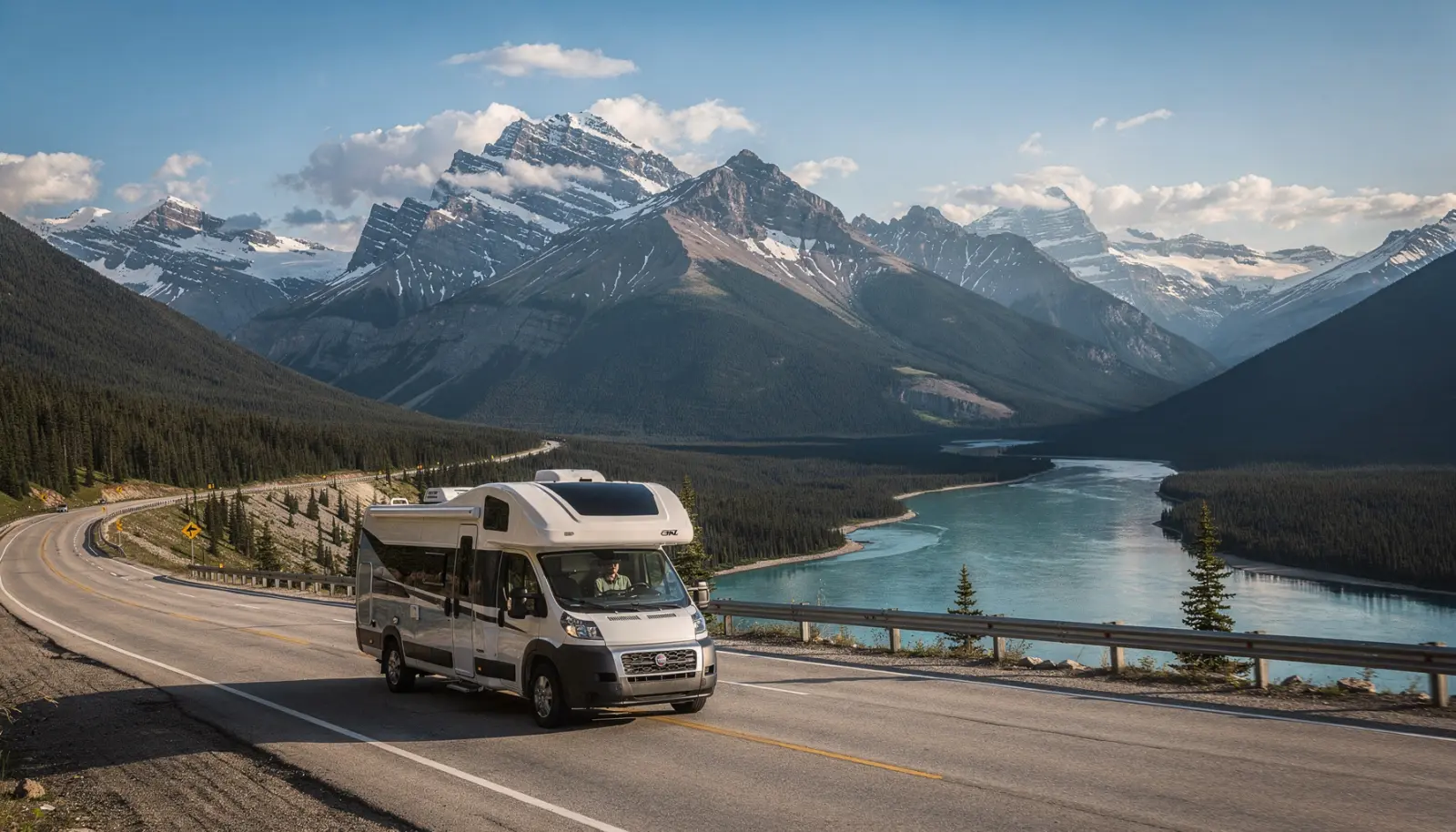
Neither is objectively the right choice. A couple who prioritises mountain driving and parking ease will lean toward a van. A family staying several days around Banff or Jasper with children to entertain on rainy days will find a motorhome's comfort worth the extra size.
Which vehicle for this trip?
For this Vancouver-to-Calgary circuit, CoolDrive Nomad offers vans and motorhomes suited to mountain roads. Our agents guide you based on group composition and your comfort with larger vehicles on mountain passes—don't hesitate to ask us directly before booking.
From 72 €/day
Frequently asked questions
What's the best time to do this circuit?
The optimal window is late June through mid-September. Outside this period, some Rockies passes and access to Banff and Jasper parks may close due to snow, making the circuit impractical for a campervan.
Do I need to book Rockies campgrounds far in advance?
Yes, from the moment Parks Canada reservations open. Spots in Banff and Jasper vanish quickly in peak season, often before campervan rentals themselves are booked. Outside the parks in British Columbia, private and municipal campgrounds are more flexible.
Is an International Driving Permit required to drive in Canada?
Not necessarily. A licence issued in your country of residence typically works for a tourist rental. It gets complicated if your licence isn't in Latin characters—then an International Driving Permit or certified translation is often needed. Rules vary by province and rental company, so verify your specific situation with the official source.
How much will fuel cost over the 1,500 km?
Budget around 250 to 500 CAD for a campervan, depending on fuel consumption. Canadian petrol costs significantly more than in the United States and remains subject to market swings: check current rates close to your departure rather than assuming a fixed price.
The route, leg by leg
LEG 1
Vancouver → Whistler
120 km · 1 hr 55After picking up your motorhome in Vancouver, allow a short day to reach Whistler: the road climbs gently through coastal forest and along inlets, with several viewpoints where you can pull over for a break. Whistler deserves more than a quick pass-through—many Nomads choose to stay an extra night here before heading on.
LEG 2
Whistler → Kamloops
300 km · 4 hr 37The landscape shifts as you travel: the humid coastal forest gives way to drier terrain as you move inland. The stage covers roughly 300 km and calls for several stops rather than straight driving. Like Whistler, Kamloops rewards a full night rather than a quick visit—we'd suggest planning to stay rather than just pass through.
LEG 3
Kamloops → Jasper
450 km · 6 hr 55This is the longest leg of the circuit, around 450 km, which easily exceeds a typical day's drive in a motorhome. Start early, build in multiple stops, or split the distance across two days if your schedule allows. Jasper, at the end of this stretch, opens onto the Rockies and serves as your gateway to the rest of the route.
LEG 4
Jasper → Banff (Icefields Parkway)
290 km · 4 hr 28This stage is the highlight of the circuit: the Icefields Parkway hugs several glaciers visible straight from the road, and natural stops at viewpoints follow one after another. The 290 km unfold at a relaxed pace, with stops whenever the mood takes you. You'll reach Banff at day's end, with time to settle in near the park for the night.
LEG 5
Banff → Calgary
130 km · 2 hrThe final leg is short and straightforward: roughly 130 km that wind down gently after several days in the mountains. It's a last chance to see the peaks one more time before heading back toward city level. Calgary marks the end of your journey—whether you're returning the motorhome there or heading back to Vancouver depends on the rental terms you chose.
LEG 6
Vancouver → Victoria (optional extension)
If you have a few extra days, an extension to Vancouver Island and Victoria rounds out the circuit nicely. It involves a ferry crossing, which needs scheduling thought rather than distance planning. You might fit it in before heading to Whistler, or save it for the end of your trip if you're returning the motorhome to Vancouver.


