
Driving a campervan in Japan means unlearning a few habits before hitting the road. Left-hand traffic, permits, road widths and fuel costs—here are the essentials to start your road trip without surprises on day one.
Before you hit the road: what changes in Japan
You drive on the left, steering wheel on the right. For someone used to driving on the right, the adjustment is real: the first kilometres require concentration, especially at major urban intersections where your instincts about priority and road positioning flip. It becomes natural quickly, but best to know this before leaving a rental office in the middle of a city rather than discovering it at your first roundabout.
On permits, the general rule is straightforward: with a licence issued in the EU or by a country recognised by Japanese authorities for international driving permits, an international permit usually suffices to drive in Japan. Two exceptions worth knowing: Japanese licences and those from certain other countries don't qualify for a standard international permit. You then need a certified translation of your licence, issued by the JAF (Japan Automobile Federation). Rules evolve and vary by bilateral agreement—best to check your situation on the JAF's official website or with your embassy before booking.
Vehicle size matters more here than elsewhere. In the Japanese Alps, roads wind along valley slopes, often narrow, with passing sections that sometimes require reversing to let a bus or truck through. Tunnels are numerous and have height restrictions you must check before entering. Same logic near temples and in city centres: car parks are designed for compact vehicles, not several-metre-long profiles. A van remains the most comfortable choice for daily driving here.
Which vehicle for this trip?
For this type of route, a van manoeuvres more easily on mountain roads, in low-height tunnels and on tightly-spaced temple car parks. This is the vehicle we recommend for this loop.
From 57 €/day
Then there's the road network itself. Japanese motorways are fast and well-maintained, but tolls are charged per kilometre and add up quickly over long distances. The alternative: secondary roads, toll-free, slower but often more interesting to drive by campervan since they pass through villages rather than bypass them.
The Nomad tip
Always keep a second route option in mind in the Japanese Alps: a tunnel too low or a road closed in winter can force you to turn back halfway. The vehicle's GPS doesn't always know height restrictions.
Where to sleep in a campervan in Japan
Japan has no campervan tradition comparable to Europe, and the accommodation system reflects this: you need to learn its codes rather than transpose habits from elsewhere.
The michi-no-eki, roadside rest stations scattered along national routes, are the first instinct for van travellers in Japan. You'll find toilets, sometimes a vending machine, often a decent view for the night. Tolerance exists for a rest stop, but it has clear limits: these aren't campsites, and some michi-no-eki explicitly forbid it by sign. The rule to remember is simple. Park discreetly, away from spaces reserved for passing customers. Never deploy an awning, table or chairs outside—this turns a tolerated stop into a base camp, which isn't permitted. Leave early in the morning. With this in mind, a michi-no-eki remains an occasional option, not a foundation for organising your days.
For real comfort like electricity, greywater disposal or showers, Japan has developed its own network of equipped areas for campervans and vans, sometimes called "RV Parks" locally. Electric hookups let you plug in heating or a fridge without draining your battery, and dump stations mean you don't have to improvise a solution after several days on the road.
Traditional campsites round out the offer, with one advantage you won't find everywhere: many are attached to an onsen, a natural hot spring. This combination is especially common in the Japanese Alps, where you can park the van for the night and finish the day in a steaming outdoor bath facing the mountains. It's often the best part of the stop, well above what "camping" conjures before you leave.
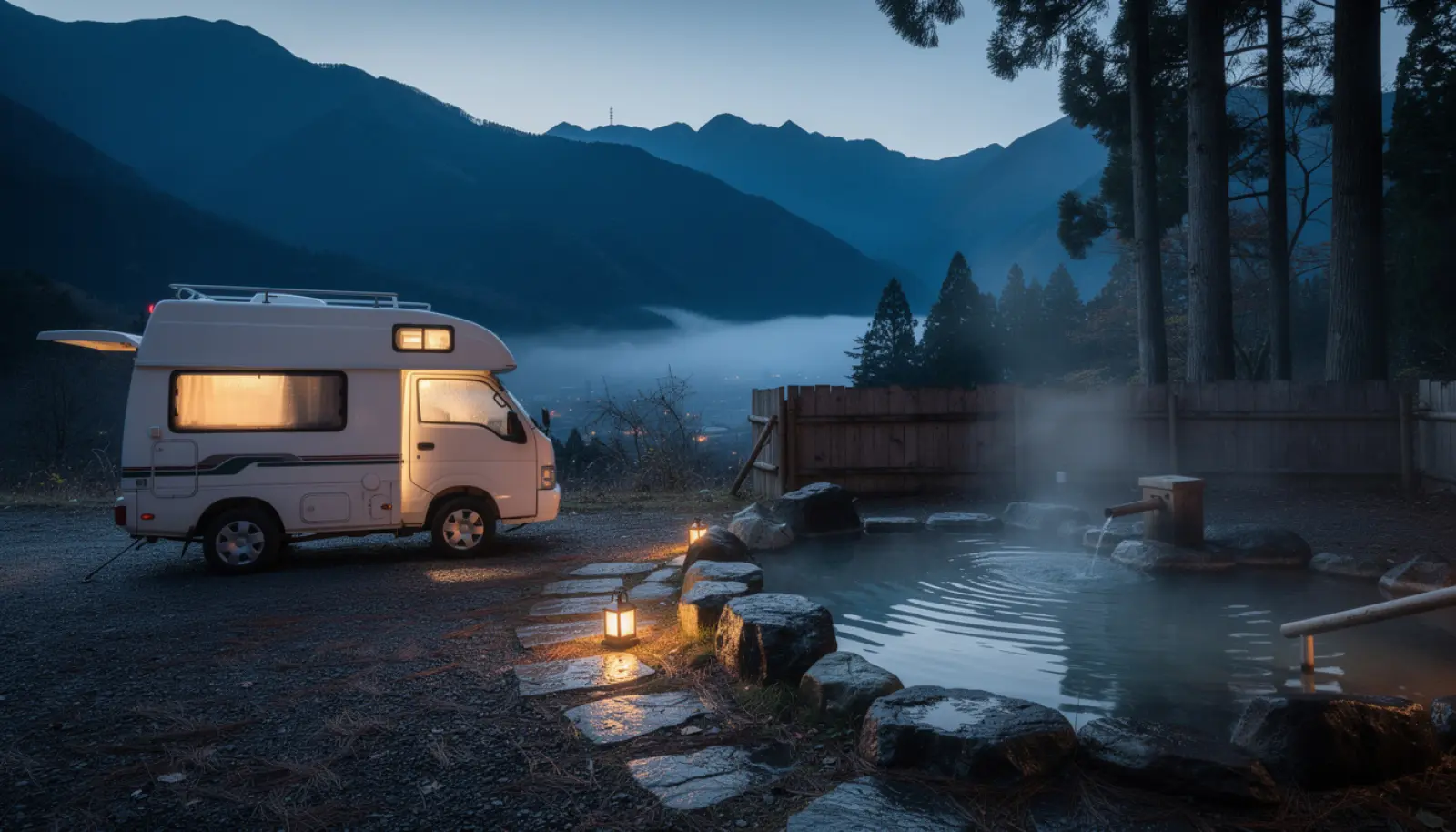
One point not to underestimate: peak season. In spring during cherry blossom season and in summer, pitches with electric hookup book up well in advance. Arriving without a reservation on an April evening in the Japanese Alps risks another hour of driving to find a spot.
The Nomad tip
Book your nights with hookup as soon as you confirm your travel dates if you're going during cherry blossom season or peak summer. Keep one or two backup michi-no-eki on your route in mind just in case your planned stop doesn't work out, but never make these your main accommodation.
Budget for a 12-day circuit
A rough guide to set realistic expectations before booking: van rental varies strongly by season, with a clear gap between low-season rates and prices during cherry blossom season or summer. Booking early often helps narrow this gap.
Here's a first idea of van rental rates in Japan. These daily rates don't include all options, insurance and other extras. Search our booking form for concrete quotes and check availability.
Campervans — Japan (Tokyo)
Sampled Sep 2026| Rental company | Vehicle | From | Mileage |
|---|---|---|---|
| Travellers Autobarn | StationwagonCampervan · 2 berths | 57 €/day | unlimited km |
| Travellers Autobarn | Chubby CamperCampervan · 2 berths | 79 €/day | unlimited km |
| Travellers Autobarn | Kuga CamperCampervan · 3 berths | 110 €/day | unlimited km |
| El Monte Japan | C16 - CaboverMotorhome · 5 berths | 158 €/day | unlimited km |
Prices sampled in September 2026 on 4 offers from 2 rental companies, for a 14-day rental starting in April 2027 (high season). Prices include taxes, in euros, excluding fees payable on site.
Every offer sampled includes unlimited mileage.
Indicative conversion at the Banque de France rate of —.
Prices vary with availability and booking date.
See today's prices →
Fuel weighs more heavily on the budget than in Europe. Petrol prices in Japan are notably higher than the European average, and even with reasonable consumption for a compact van, costs add up fast on a loop crossing Tokyo, the Japanese Alps and Kanazawa. Budget this as one of your heaviest expenses, alongside tolls.
Which brings us to tolls. Japanese motorways are charged per kilometre (roughly 30 yen/km), and on a circuit this size, the total bill can run to tens of thousands of yen. The ETC, the electronic toll system often installed in rental vehicles, doesn't necessarily cut costs but changes everything at barriers: no stops, no change to hunt for, you pass under a gantry and the tag does the rest. Ask for it explicitly when picking up the van if it's not already fitted.
Two costs remain easy to overlook when planning a first Japan trip. First, showers and onsen: if your overnight spots don't include facilities, a dip in a hot spring costs a few hundred yen and quickly becomes a daily necessity rather than an occasional expense. Then food—actually good news in this budget: konbini convenience stores, open round the clock, and local markets let you eat well for reasonable money, well below restaurant prices for every meal. That's where a van with basic kitchen equipment makes the difference: cooking two meals out of three from konbini or market produce makes a real difference over twelve days.
The Nomad tip
Bring a credit card with no foreign transaction fees and some yen cash: some tolls, michi-no-eki and small rural shops won't take cards, especially outside major cities.
Frequently asked questions
Can you rent a campervan in Japan on a foreign licence?
In most cases yes, provided you have a valid international driving permit. Exceptions mainly concern German and Swiss licence holders, who need a certified JAF translation rather than a standard international permit. Always check your situation on the JAF website before booking.
Is left-hand driving a real problem for a first trip?
If you've never driven on the left, the first kilometres outside the city need particular attention, especially at intersections. Once you get past that, driving becomes quickly more natural, especially since the Japanese road network is generally well-signposted and well-maintained.
Can you sleep anywhere in a van in Japan?
No. Michi-no-eki tolerate a rest stop but not a full night's parking, and some forbid it outright. For proper accommodation with electricity and waste disposal, RV Parks and campsites remain the solution, especially in peak season.
Is a van enough for this circuit, or do you need a larger vehicle?
For this Tokyo—Japanese Alps—Kanazawa loop, a van is the most comfortable choice. Mountain roads, tunnels with height limits and temple car parks are sized for compact vehicles, not larger profiles.
The route, leg by leg
LEG 1
Tokyo → Kawaguchiko (Fuji Five Lakes)
100 km · 1 hr 50The city gives way to hills as you leave the metropolitan area, and Mount Fuji gradually emerges on the horizon. Set up on the shores of Lake Kawaguchiko: on clear days, the snow-capped summit reflects in the water at sunrise. Plan a full day here to enjoy the view before hitting the road again.
LEG 2
Kawaguchiko → Matsumoto
90 km · 1 hr 30The road climbs toward the Japanese Alps, leaving Fuji in the rearview mirror. Matsumoto can be visited in half a day: its 16th-century black castle, one of the few in Japan to have kept its original structure, is visible from a distance. Park the campervan for the night before the ascent to Kamikochi.
LEG 3
Matsumoto → Sawando (gateway to Kamikochi)
60 km · 1 hr 40Here, the rule is clear and non-negotiable: the Kamikochi valley is closed to private vehicles year-round. Leave your campervan at the Sawando parking lot, and a shuttle bus will take you into the valley—check the time of the last shuttle in the evening so you don't get stranded. The reward is worth the constraint: a glacial river, peaks over 3,000 metres, and a silence you won't find anywhere else on this route.
LEG 4
Sawando → Takayama
70 km · 1 hr 25After this mountain interlude, the road descends toward Takayama, a wooden town that has survived the centuries without major fires or bombardments. The old Sanmachi district is best explored on foot, past sake breweries and dark timber-fronted buildings. A spot on the outskirts is enough for the night; the town centre is not suited for campervan parking.
LEG 5
Takayama → Shirakawa-go
50 km · 1 hr 10Barely fifty kilometres separate the two villages, but the landscape changes completely. The thatched roofs of the gassho-zukuri houses, shaped to withstand heavy winter snows, come into view from the Shiroyama viewpoint in the late afternoon. The village closes to private cars during the day: arriving in the late afternoon lets you see it empty of tour buses.
LEG 6
Shirakawa-go → Kanazawa
100 km · 2 hrThe road descends toward the coast and Kanazawa, where three nights make more sense than one. The Omicho market is best visited early, before stalls of crab and sea urchin are picked clean by neighbourhood restaurants. Kenroku-en Garden, one of Japan's three great traditional gardens, is worth saving for late afternoon when the light rakes across the pruned pines.
LEG 7
Kanazawa → roadside rest area (halfway point back to Tokyo)
175 km · 3 hrThe 350 kilometres separating Kanazawa from Tokyo can be driven in a single day in a car, but not in a campervan. Split the journey and stop halfway at a motorway service area rather than arriving exhausted in Tokyo in the middle of the night. This route deliberately leaves Kyoto and Osaka aside: getting there from here would add at least four to five days to your trip, beyond the timeframe proposed here.
LEG 8
Roadside rest area → Tokyo
175 km · 3 hrFinal stretch on the motorway, with urban density gradually increasing as you approach the capital. Plan to return the campervan in late morning rather than at the last minute: rush-hour traffic around Tokyo is not the relaxing end to a trip you'd want.
